Key Takeaways
- Magnesium supports normal nerve and muscle function and may help the body relax, particularly when magnesium intake is inadequate.
- Clinical evidence shows a modest sleep benefit with magnesium supplementation, especially in people with low magnesium intake or status.
- Magnesium glycinate and L-threonate have been shown in human clinical trials to be useful forms.
- Despite magnesium's essential role in muscle function, controlled trials do not show a consistent benefit for nighttime leg cramps.
- Magnesium can interfere with certain antibiotics and osteoporosis medications.
- People with kidney disease should use magnesium supplements only with medical guidance.
What Is Magnesium and Why Is Supplementation Important?
Magnesium is involved in more than 800 enzyme systems, including processes that regulate nerve signaling, muscle contraction, energy production, and normal heart rhythm.1 National survey data indicate that 48% of Americans consume less magnesium from food and beverages than their estimated average requirement.1 Magnesium supplementation is a viable strategy to boost the dietary intake of this important mineral.
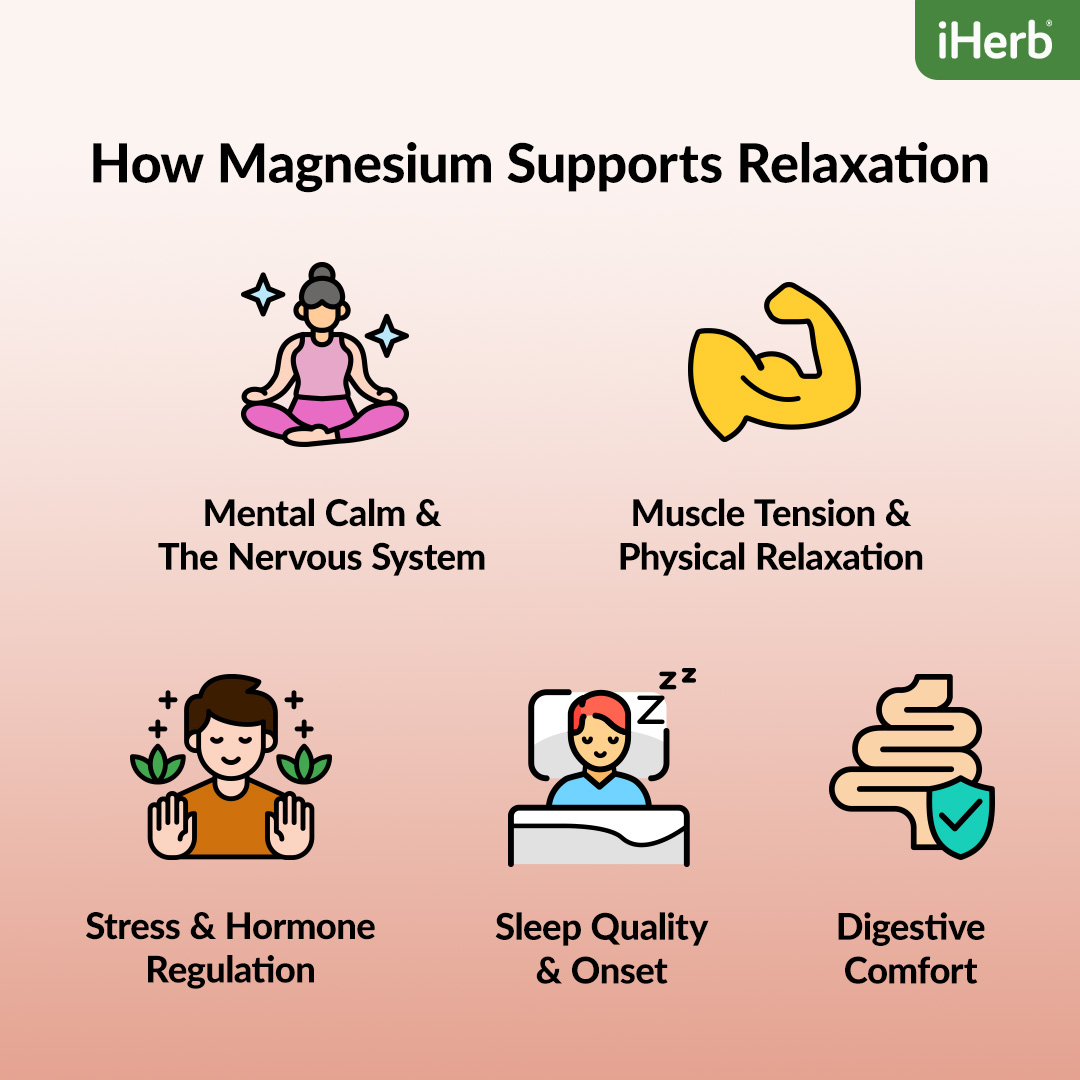
How Magnesium Supports Relaxation
Nervous System Regulation
Magnesium helps regulate excitatory signaling at NMDA receptors and participates in pathways involving GABA, the brain's principal inhibitory neurotransmitter.2 These mechanisms provide a biochemical basis for a calming effect.
Muscle Relaxation and Cramps
Magnesium is essential for normal muscle contraction and neuromuscular signaling, but supplementation does not consistently relieve nocturnal cramps. A 2020 Cochrane review concluded that magnesium was unlikely to provide clinically meaningful cramp prevention in older adults, while evidence in pregnancy remained uncertain.3 Topical magnesium and Epsom salt baths are also popular for muscle tension, but meaningful absorption of magnesium through the skin has not been demonstrated.
Stress
Low magnesium status has been associated with stress, and magnesium participates in regulation of the hypothalamic-pituitary-adrenal stress-response system. In an eight-week randomized trial involving adults with severe stress and low magnesium levels, both magnesium alone and magnesium plus vitamin B6 reduced feelings of stress. The combination produced a greater improvement in the subgroup with severe or extremely severe stress.4 A secondary analysis found that vitamin B6 did not significantly increase erythrocyte magnesium beyond magnesium alone, so the added benefit cannot be attributed simply to improved magnesium absorption and may be due to other aspects of B6 function.5
Magnesium and Sleep: What Clinical Trials Show
Research indicates that magnesium may support relaxation and healthy sleep, although results vary among studies. A review of three clinical trials in older adults found that magnesium helped participants fall asleep sooner, but did not significantly increase total sleep time.6
Earlier research in older adults also found improvements in sleep quality and sleep efficiency, along with favorable changes in melatonin and cortisol levels.7 A large observational study similarly associated higher magnesium intake with healthier sleep patterns.8
Recent research has produced more encouraging results with both magnesium glycinate and L-threonate. In a 2025 clinical trial, magnesium glycinate provided modest support for sleep quality, with the greatest improvements observed among participants whose diets were lower in magnesium.9 Magnesium L-threonate showed even greater promise in a 2024 clinical trial, as it was shown to support several other measures of sleep quality, including deep and REM sleep, as well as next-day alertness, mood, and productivity.10
Overall, the research suggests that magnesium may offer modest sleep support, particularly for people with inadequate magnesium intake. Best results may be achieved with magnesium L-threonate compared to other forms.9-11
Which Form of Magnesium Is Best for Relaxation and Sleep?
Among the various forms of magnesium, magnesium L-threonate has produced the most impressive sleep-specific results, making it the leading choice when sleep quality and daytime mental performance are the primary goals.
Magnesium glycinate (bisglycinate) is also a reasonable option. Magnesium citrate and magnesium oxide can also provide effective magnesium supplementation. Both of these forms may promote bowel regularity, particularly at higher doses, which can be helpful when occasional constipation contributes to discomfort at bedtime.
How Much Magnesium Should You Take, and What Does "Elemental" Mean?
The Supplement Facts panel lists elemental magnesium, which is the amount that matters when determining dosage. The adult Recommended Dietary Allowance is 310 to 320 mg daily for women and 400 to 420 mg for men from all sources. The adult tolerable upper intake level is 350 mg daily from a dietary supplement.1
Food Sources of Magnesium
Pumpkin seeds, almonds, leafy green vegetables, beans, whole grains, and dark chocolate provide magnesium. Improving dietary intake is the logical first step for people whose diets are low in these foods. Supplements can then fill a remaining gap. A detailed breakdown of magnesium-rich foods and how much they provide per serving is covered in iHerb's dedicated food-sources guide.
When to Take Magnesium for Sleep and Relaxation
Most trials, including the Schuster 2025 study, dosed magnesium once daily without specifying a strict time of day relative to bedtime, so there is no single research-backed "optimal minute." That said, a common and reasonable approach, consistent with how magnesium was dosed across the sleep trials described above, is to take it 30 to 60 minutes before the intended bedtime, giving it time to be absorbed before you're trying to fall asleep.
Based upon existing clinical research, consistency of supplementation matters more than precise timing. Better results are seen with regular intake, presumably as it leads to higher body magnesium levels.
Common Side Effects
Magnesium supplements are generally well tolerated when taken in appropriate amounts. A small percentage of people may experience loose stools, diarrhea, abdominal cramping, or nausea at single dosages greater than 250 mg. These effects often improve by reducing the amount, dividing it between meals, or taking it with food. Individual tolerance can vary, but gastrointestinal effects are not limited to any one form of magnesium.
Excessive magnesium accumulation is rare in people with normal kidney function because the kidneys efficiently eliminate surplus magnesium. People with impaired kidney function may not clear magnesium as effectively and should consult a healthcare professional before using a magnesium supplement.
Who Is Most Likely to Notice a Difference?
People with low dietary intake or an increased risk of magnesium insufficiency are the most likely to experience the greatest benefit. Risk factors for low magnesium levels include gastrointestinal disorders that impair absorption, type 2 diabetes, older age, alcohol dependence, and long-term use of certain medications.1
Interactions and Who Should Be Careful
Magnesium is generally safe for most healthy adults at recommended doses, but it can interact meaningfully with certain medications and health conditions.
- Bisphosphonates: The US National Institutes of Health (NIH) documents that magnesium reduces the absorption of oral bisphosphonates such as alendronate, used for osteoporosis; spacing doses at least 2 hours apart is advised.
- Antibiotics: Magnesium can bind to tetracycline and quinolone antibiotics, reducing their absorption; these should be taken at least 2 hours before or 4 to 6 hours after magnesium.
- Proton pump inhibitors (PPIs): Long-term PPI use for acid reflux or ulcers can cause low magnesium levels with extended use.
- Diuretics: Loop and thiazide diuretics can increase magnesium loss in urine; potassium-sparing diuretics have the opposite effect. Either direction can shift magnesium status enough to matter.
- Blood pressure medications: Magnesium has a mild blood-pressure-lowering effect of its own, so combining it with antihypertensive medication can occasionally lower blood pressure more than intended.
- Kidney disease: Reduced kidney function raises the risk of magnesium buildup to unsafe levels (hypermagnesemia), since the kidneys are the primary route for clearing excess magnesium. This is especially relevant for magnesium oxide used at bowel-irregularity-relief doses.
Anyone taking prescription medication, managing a chronic health condition, or pregnant or breastfeeding should talk with a healthcare professional before starting a magnesium supplement.
The Bottom Line
Magnesium supports the nerve and muscle processes involved in relaxation, but it is not act like a sleeping pill. Clinical trials indicate that supplementation may improve sleep, especially when magnesium intake is low. Magnesium L-threonate and glycinate may produce better results compared to other forms. Choose a reputable product based on its elemental magnesium dose, individual tolerance, and the intended use, and combine it with established sleep practices such as a consistent schedule, a dark bedroom, limited late-day caffeine, etc. Browse iHerb's full range of magnesium supplements to find a form that fits your routine.
FAQ
Does magnesium actually help with relaxation?
It may help support relaxation through normal nerve and muscle function, particularly when magnesium intake or status is low. It is not an immediate sedative, and clinical effects are generally modest.
Is magnesium glycinate good for sleep and relaxation?
Magnesium bisglycinate produced a small improvement in sleep quality in one recent randomized trial.9 It is a reasonable option, but results from a recent study with magnesium L-threonate were more impressive.
Can magnesium help tense muscles or nighttime cramps?
Magnesium is essential for normal muscle function, but supplementation has not consistently prevented nighttime cramps in controlled trials.3
Does magnesium help if you are not deficient?
Possibly, but the benefit may be smaller. Evidence suggests a greater response among people with lower magnesium intake.9
How much magnesium should I take for sleep?
No specific dose has been established for sleep. Check the Supplement Facts panel for elemental magnesium and count magnesium from all supplements and medications. The adult upper limit from these sources is 350 mg daily unless a healthcare professional recommends otherwise.1
Is magnesium safe to take every night?
For most healthy adults, an appropriate dose is generally suitable for regular use. People with kidney disease or relevant medication interactions should seek medical guidance first. Reduce the dose or stop using it if persistent diarrhea or other adverse effects develop.
References:
- National Institutes of Health Office of Dietary Supplements. Magnesium: Fact Sheet for Health Professionals. Updated January 6, 2026. Accessed September 16, 2026. https://ods.od.nih.gov/factsheets/Magnesium-HealthProfessional/
- de Baaij JHF, Hoenderop JGJ, Bindels RJM. Magnesium in man: implications for health and disease. Physiol Rev. 2015;95(1):1-46. doi:10.1152/physrev.00012.2014
- Garrison SR, Korownyk CS, Kolber MR, et al. Magnesium for skeletal muscle cramps. Cochrane Database Syst Rev. 2020;9(9):CD009402. doi:10.1002/14651858.CD009402.pub3
- Pouteau E, Kabir-Ahmadi M, Noah L, et al. Superiority of magnesium and vitamin B6 over magnesium alone on severe stress in healthy adults with low magnesemia: a randomized, single-blind clinical trial. PLoS One. 2018;13(12):e0208454. doi:10.1371/journal.pone.0208454
- Noah L, Pickering G, Mazur A, et al. Impact of magnesium supplementation, in combination with vitamin B6, on stress and magnesium status: secondary analysis of a randomised controlled trial. Magnes Res. 2020;33(3):45-57. doi:10.1684/mrh.2020.0468
- Mah J, Pitre T. Oral magnesium supplementation for insomnia in older adults: a systematic review and meta-analysis. BMC Complement Med Ther. 2021;21(1):125. doi:10.1186/s12906-021-03297-z
- Abbasi B, Kimiagar M, Sadeghniiat K, et al. The effect of magnesium supplementation on primary insomnia in elderly: a double-blind placebo-controlled clinical trial. J Res Med Sci. 2012;17(12):1161-1169.
- Zhang Y, Chen C, Lu L, et al. Association of magnesium intake with sleep duration and sleep quality: findings from the CARDIA study. Sleep. 2022;45(4):zsab276. doi:10.1093/sleep/zsab276
- Schuster J, Cycelskij I, Lopresti AL, Hahn A. Magnesium bisglycinate supplementation in healthy adults reporting poor sleep: a randomized, placebo-controlled trial. Nat Sci Sleep. 2025;17:2027-2040. doi:10.2147/NSS.S524348
- Hausenblas HA, Lynch T, Hooper S, Shrestha A, Rosendale D, Gu J. Magnesium-L-threonate improves sleep quality and daytime functioning in adults with self-reported sleep problems: a randomized controlled trial. Sleep Med X. 2024;8:100121. doi:10.1016/j.sleepx.2024.100121
- Rawji A, Peltier MR, Mourtzanakis K, et al. Examining the effects of supplemental magnesium on self-reported anxiety and sleep quality: a systematic review. Cureus. 2024;16(4):e59317.
DISCLAIMER:
These statements have not been approved by the Food and Drug Administration. These products are not intended to diagnose, treat, cure, or prevent disease.


























































 Table of Contents